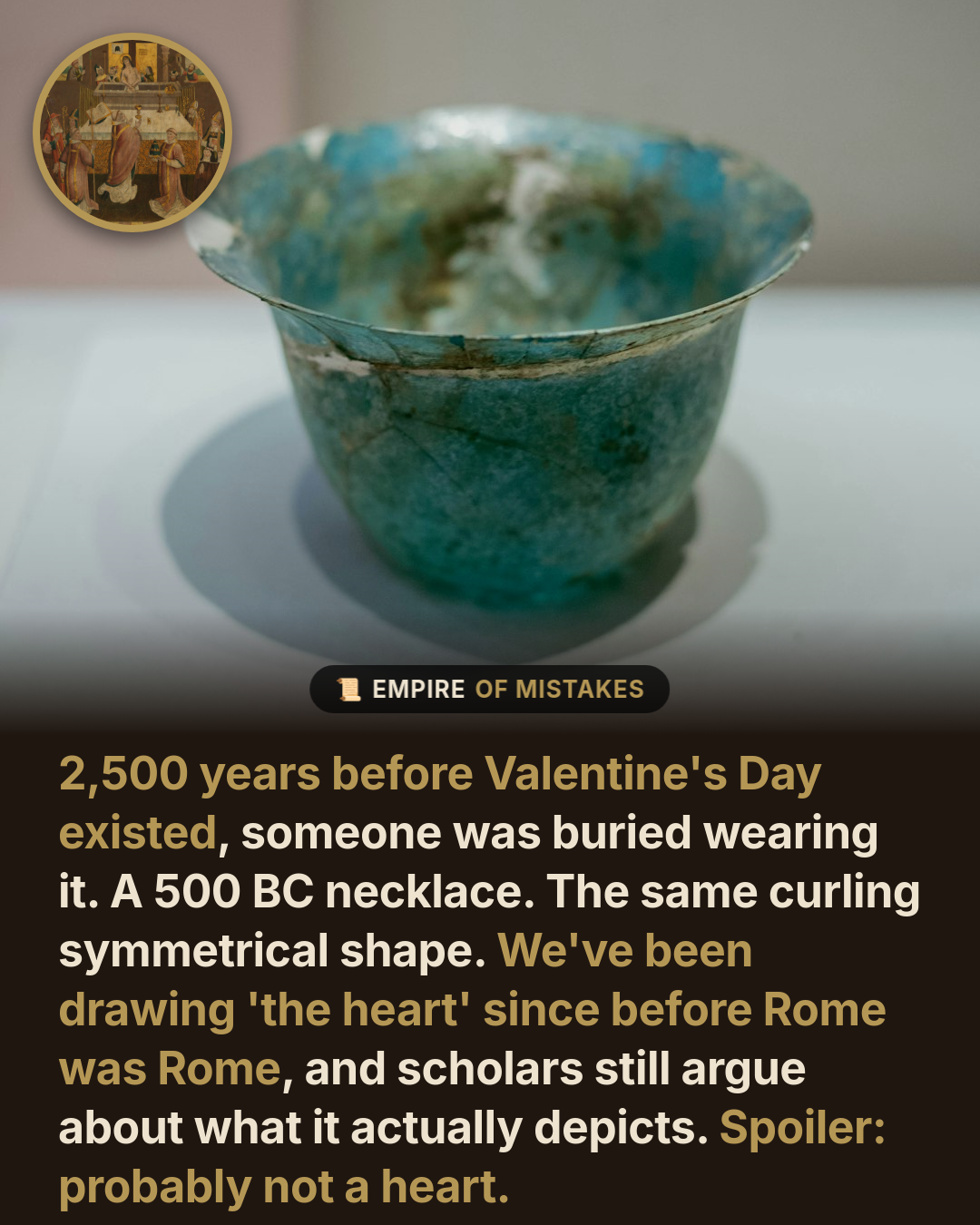
Here's the number that stops a room: the shape we slap on Valentine's cards every February 14th appears on burial jewellery dated to roughly 500 BC, which is, to be precise, about 1,800 years before medieval European manuscripts supposedly 'invented' it.
A museum visitor recently noticed this while staring at a necklace recovered from an Iron Age burial site. The piece featured paired, inward-curling motifs, symmetrical, tapering to a point at the base, that any modern eye would immediately clock as a heart symbol. The visitor's question was a good one: does mainstream history have this badly wrong?
The textbook answer places the romantic heart symbol in 13th - 14th century Europe, particularly in French and Flemish manuscript illuminations where it shows up in courtly love scenes. By 1344, it's appearing in the illustrated Roman de la Poire, a man literally handing his heart to a woman. Clean origin story. Except it isn't.
Ancient Greco-Roman decorative traditions used the ivy leaf, hedera helix, extensively, and that leaf is, frankly, a dead ringer for the modern heart shape. Silphium, a now-extinct North African plant traded out of Cyrene (modern Libya) around 600 - 400 BC, produced seed pods that appear on coins in a shape indistinguishable from the contemporary symbol. Cyrene's economy ran so heavily on silphium exports that the city put the seed on its coinage. Whether silphium's association with contraception and fertility gave the shape its romantic cargo is a genuinely open debate among classicists.
The honest scholarly position is that no single continuous chain of transmission has been proven. What likely happened is messier and more interesting: a recurring visual form, two curves meeting a point, kept getting rediscovered and reloaded with new meaning across different cultures, because the shape is geometrically satisfying and anatomically suggestive enough to attract symbolism like a magnet.
As for whether it depicts an actual human heart, it doesn't, not even close. The cardiac organ looks like a fist someone sat on. Medieval anatomists working from Galen's texts described a three-chambered heart with a visible depression at the top, which does resemble the symbol more closely. So the shape may be a 13th-century attempt at medical illustration that got romantically hijacked.
What's your read, geometric coincidence, or is there a thread running all the way back to Iron Age jewellers?